

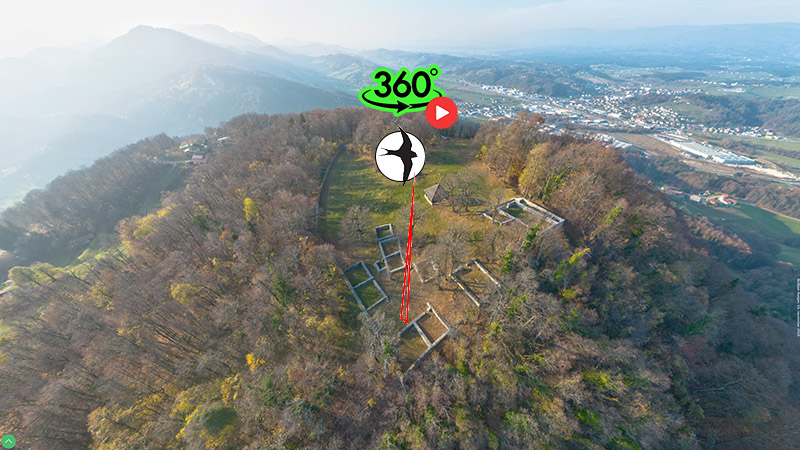
Rifnik near Šentjur is the largest Late Antique settlement in Slovenia, whose rich history from prehistory to the early Middle Ages makes it one of the most important archaeological areas in the country.
Historical Background
Rifnik is a prominent hill south of Šentjur, rising above the valley of the Voglajna River. Because of its strategic location, it was inhabited as early as the Neolithic period (around 4000 BC), and later during the Bronze and Iron Ages. In the Roman period, the area became an important settlement center, reaching its peak in Late Antiquity (4th–6th centuries).
The Late Antique Settlement
- In Late Antiquity, Rifnik was the largest hilltop settlement in Slovenia, covering the entire upper plateau of the hill.
- The settlement was fortified with walls and watchtowers, allowing its inhabitants to defend themselves against barbarian invasions.
- Archaeologists discovered the foundations of seven houses, some built of stone and even equipped with central heating systems, showing a high level of living culture.
- A key feature of the settlement were two early Christian churches, confirming that Rifnik became one of the earliest Christian centers in Slovenia.
- The settlement also had a cistern for water, which made permanent habitation on the hill possible.
Religious and Cultural Significance
At the highest point of Rifnik, archaeologists uncovered remains of a temple dedicated to the local deity Aquona, associated with the Voglajna River. This illustrates the coexistence of pagan traditions and early Christianity, typical of the transitional period of Late Antiquity.
Archaeological Research
The first excavations were carried out during World War II by Walter Schmid. Later, Slovenian archaeologists such as Lojze Bolta and Darja Pirkmajer continued the work, documenting several building phases of the settlement. Today, the finds are preserved in the Celje Regional Museum as part of the "Rifnik and Its Treasures" exhibition.
End of the Settlement
The settlement declined in the second half of the 6th century, when the Slavs arrived in the region. Their arrival marked the end of the Romanized community and the beginning of a new early medieval period.
Rifnik Today
Rifnik is arranged as an archaeological park, open year‑round. Visitors can see the foundations of the buildings and a reconstructed prehistoric house. Due to its location, it is also a popular hiking destination.
Comparison with Other Late Antique Settlements
Ajdna nad Potoki
- Location
- 1064 m, rocky ridge of the Karawanks
- Function
- Spiritual center of a refugee community
- Feature
- Distinctive defensive and crisis function
Ajdovski gradec
- Location
- Hill above Sevnica
- Function
- Regional Christian center
- Feature
- Church complex with baptistery
Rifnik near Šentjur
- Location
- Elevation above Šentjur
- Function
- Religious and administrative center
- Feature
- Largest hilltop settlement
Tonovcov grad
- Location
- Terrace above the Soča River
- Function
- Religious center along a traffic route
- Feature
- Connection to the Romanization of the region
Sources: Walter Schmid, Lojze Bolta, Darja Pirkmajer, Celje Regional Museum.