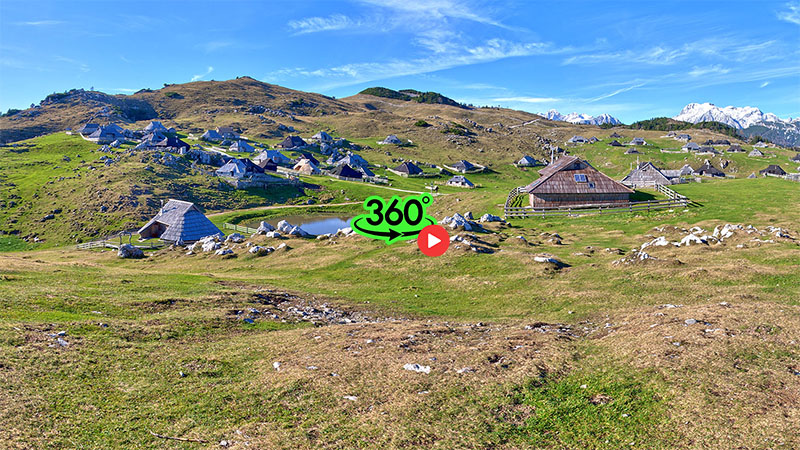
Velika planina is an extensive high‑mountain karst plateau on the southern edge of the central Kamnik–Savinja Alps. Covering approximately 12 km², it is one of the largest and most distinctive alpine pastures in Slovenia. It comprises several traditional grazing areas: Velika planina to the east, Mala planina to the south, Gojška planina and Planina Dovje to the east, and Planina Konjšica to the north. Elevations range from around 1400 m (Šimnovec) to the highest point, Gradišče (1668 m). Other notable summits include Bukovec (1552 m), Koritni vrh (1648 m), Dovja griča (1534 m) and Poljanski rob (1570 m).
The central and southern parts of the plateau form the largest alpine pasture in Slovenia, where seasonal grazing has been maintained for centuries. Near Gradišče lies the natural feature Vetrnica, a prominent collapse doline and one of the most characteristic karst forms on the plateau.
Geology and geomorphology
Velika planina is built of Triassic limestones and dolomites, heavily fractured and highly susceptible to karstification. Because water rapidly infiltrates the bedrock, the plateau has almost no surface streams. Instead, it is shaped by a dense network of dolines, collapse depressions, karren, runnels, and small karst basins, many of which were historically adapted by herders to collect water.
The landscape is the result of a combination of Pleistocene glacial processes and later karst corrosion. Glaciers once smoothed and levelled the surface, while post‑glacial rainwater carved it into the present mosaic of undulating grassy surfaces, sharp limestone ridges, and rugged karst microforms.
History of settlement and pastoral culture
Velika planina was never permanently settled in the conventional sense, but it has been seasonally inhabited since at least the Middle Ages. Herders moved to the plateau during the summer months—typically from June to September—forming self‑contained seasonal communities with their own architecture, customs, and pastoral practices.
The plateau reached its greatest development in the 16th and 17th centuries, when the main herding settlements were established:
-
Veliki stan,
-
Mali stan,
-
Gojški stan,
-
Dovji stan.
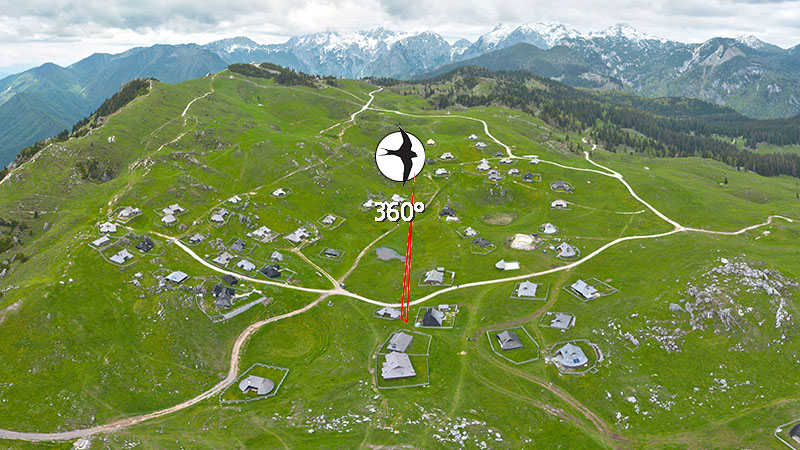
The most distinctive feature of the plateau is its wooden herdsmen’s huts, with low, circular roofs covered with wooden shingles that extend almost to the ground. This architectural form is perfectly adapted to wind, snow, and local materials, and today represents one of the most iconic alpine cultural landscapes in Slovenia.
Above Veliki stan stands the wooden Chapel of Our Lady of the Snows (1560 m), originally built in 1938 according to the designs of architect Jože Plečnik.
Aerial view:
During the Second World War, Velika planina suffered the greatest devastation in its history:
All herdsmen’s huts—without exception—were burned down.
Plečnik’s Chapel of Our Lady of the Snows was also destroyed.
The destruction was carried out in 1945 by Slovenians collaborating with the Nazi occupation forces. Their intention was to prevent the plateau from serving as a refuge, supply route, or support point for the Slovenian resistance army against Nazi occupation (the partisans). The devastation was total: a cultural landscape shaped over centuries disappeared in a single act.
The chapel was rebuilt in 1988, exactly fifty years after its original construction, following Plečnik’s architectural concept. The herdsmen’s huts were gradually reconstructed; many of them today serve as holiday cottages, preserving the traditional form while accommodating modern use.
Access
Velika planina is easily accessible today:
-
from Kamnik via the route past St. Primož,
-
by cable car from the Kamniška Bistrica valley,
-
from the east via Gojška and Mala planina, where a road leads to the upper plateau.
Significance of Velika planina
Velika planina is exceptional for:
-
its pastoral cultural heritage,
-
its high‑mountain karst landscape,
-
its wartime history and post‑war reconstruction,
-
its panoramic views of the Kamnik–Savinja Alps,
-
its preserved identity, which remains strong despite the destruction of the 20th century.
It is one of the most beautiful, culturally rich, and visually striking high‑mountain landscapes in Slovenia.