

Veliko Blejsko barje (the Great Bled Bog) is one of the largest and most recognisable raised bogs on the Pokljuka Plateau. It lies at an elevation of around 1,250 metres, on a broad, gently levelled plateau surrounded by spruce forests characteristic of this part of the Julian Alps. With its size, well‑preserved domed structure, and rich bog vegetation, it represents the central raised‑bog core of Pokljuka and one of the most important remnants of southern Alpine ombrotrophic bogs.
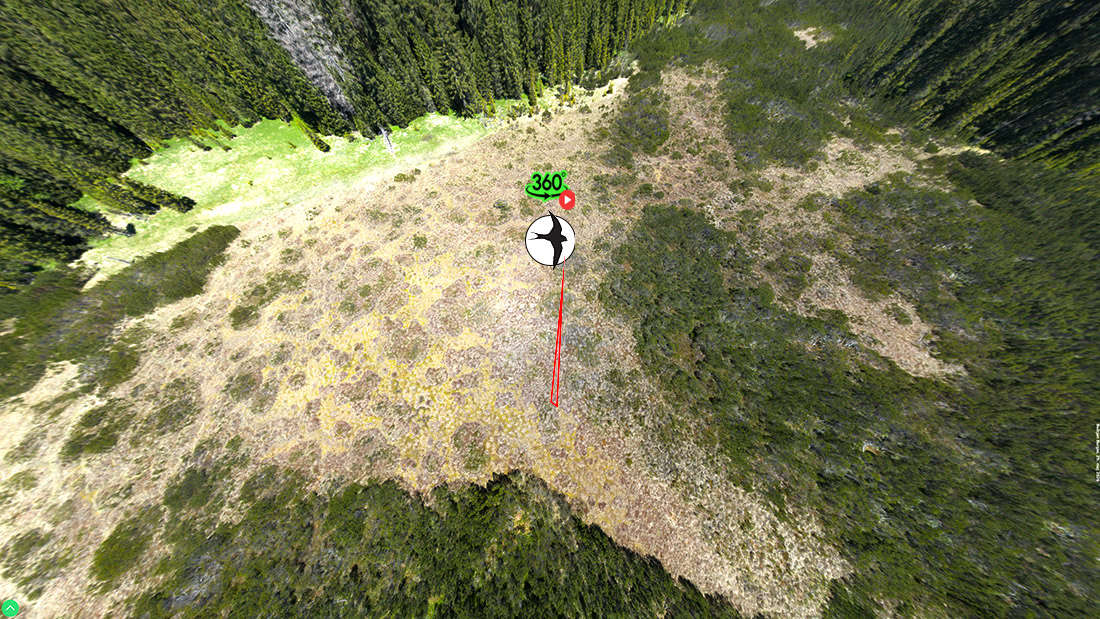
Because of its extent and diversity of microhabitats, Veliko Blejsko barje is crucial for understanding post‑glacial bog development and for conserving numerous rare and specialised species that have disappeared from much of Europe.
Formation – a legacy of glacial history
Like other Pokljuka bogs, Veliko Blejsko barje formed after the retreat of the Bohinj Glacier, approximately 12,000–18,000 years ago. The glacier left behind a broad, shallow depression with an impermeable clay‑silt substrate. Small ponds persisted in this basin and gradually filled with organic remains of aquatic plants.
Due to acidic, cold, and oxygen‑poor conditions, these remains did not decompose but accumulated as peat. Over time, the growth of Sphagnum mosses raised the bog surface into a characteristic dome, which is still clearly visible today and represents one of the largest domed structures on Pokljuka.
Hydrological characteristics – a fully ombrotrophic system
Veliko Blejsko barje is distinctly ombrotrophic, meaning it is fed exclusively by:
-
rainwater,
-
snowmelt,
-
atmospheric moisture.
The water is:
-
highly acidic (pH often below 4.5),
-
extremely nutrient‑poor,
-
constantly present, as it remains trapped above the impermeable substrate.
This stable hydrological regime enables the development of complex bog communities that are extremely sensitive to changes in water balance.
Microrelief – the articulated structure of the dome
Veliko Blejsko barje has a well‑developed domed shape, composed of:
-
Sphagnum hummocks – elevated, drier areas formed by dense moss growth,
-
wet hollows (pools) – shallow depressions where water persists,
-
transitional zones, where vegetation intermingles and creates a remarkable diversity of microhabitats.
This microrelief is essential for the richness of plant and animal species, as it supports organisms adapted to different levels of moisture, light, and nutrient availability.
Vegetation – the richness of Sphagnum mosses and bog plants
Veliko Blejsko barje is botanically very rich. Its core is formed by Sphagnum mosses (Sphagnum spp.), the primary peat‑forming organisms. The most common species include:
-
Sphagnum magellanicum,
-
Sphagnum fuscum,
-
Sphagnum rubellum,
-
Sphagnum cuspidatum in wet hollows.
In addition to mosses, many characteristic bog plants thrive here:
-
round‑leaved sundew (Drosera rotundifolia) – a carnivorous plant,
-
bog rosemary (Andromeda polifolia) – a typical raised‑bog species,
-
small cranberry (Oxycoccus palustris) – with creeping stems and small red berries,
-
bog bilberry (Vaccinium uliginosum),
-
sedges (Carex spp.),
-
deergrass (Trichophorum cespitosum).
Along the margins of the bog appear spruce, dwarf pine, lingonberry, and bilberry, marking the transition to drier habitats.
Fauna – a refuge for specialised species
Veliko Blejsko barje provides habitat for numerous animal species adapted to wet, cold, and nutrient‑poor environments.
Butterflies
-
the scarce bog blue (Plebejus optilete),
-
the large heath (Coenonympha tullia),
-
several rare nocturnal moths.
Birds
-
black woodpecker,
-
three‑toed woodpecker,
-
Tengmalm’s owl in the surrounding forests.
Amphibians and insects
-
alpine newt,
-
common toad,
-
numerous mosquito and midge species forming an important part of the food web.
Because of its size and habitat diversity, Veliko Blejsko barje is one of the most important refuges for bog‑dependent species on Pokljuka.
Climate conditions – cold, humid, and stable
The bog is characterised by:
-
long‑lasting snow cover,
-
high air humidity,
-
frequent fog,
-
cold summer nights,
-
slow decomposition of organic matter, enabling peat formation.
These conditions are essential for maintaining the bog ecosystem.
Protection – a strictly protected area
Veliko Blejsko barje is part of Triglav National Park and is subject to the strictest protection regime. Due to its extreme sensitivity:
-
movement is allowed only on marked paths,
-
stepping onto the peat surface is prohibited,
-
all interventions in the hydrological regime are forbidden,
-
monitoring of overgrowth and invasive species is continuous.
Damage to the peat surface may take several decades to heal, which is why protection is exceptionally strict.
Importance for science and nature
Veliko Blejsko barje is exceptionally important because of:
-
the archival properties of peat, which preserves pollen, charcoal, plant remains, and evidence of past climates,
-
its role in the hydrological regime of Pokljuka,
-
its outstanding biodiversity,
-
its status as one of the largest southern Alpine raised bogs,
-
its excellent preservation, which enables research into post‑glacial bog development.
It is one of the finest examples of how nature transformed after the retreat of the glaciers into a unique, sensitive, and highly specialised ecosystem, now found only in a few places across Europe.