

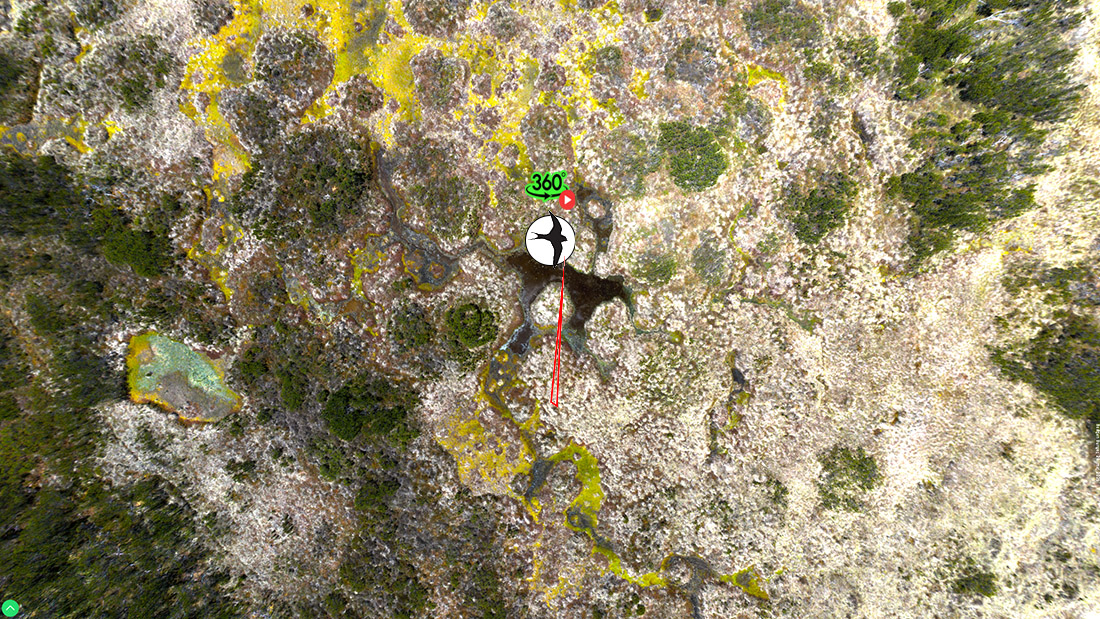
The Šijec peat bog is the most characteristic, best‑preserved, and ecologically most complete peat bog on the Pokljuka Plateau. It lies in the southeastern part of the plateau, at an elevation of around 1,300 metres, where an unexpectedly open, flat bog landscape emerges from the surrounding spruce forests. With its pronounced domed shape, rich microrelief, and exceptional diversity of bog vegetation, Šijec is considered a reference example of a southern Alpine peat bog – an ecosystem that is extremely rare and fragile in Europe.
Formation – a legacy of the retreating glacier
Šijec formed after the end of the last Ice Age, when the Bohinj Glacier retreated and left behind a series of shallow depressions with impermeable bottoms. One of these depressions retained water, in which the remains of aquatic plants accumulated. Due to cold, acidic, and oxygen‑poor conditions, these remains did not decompose but slowly built up as peat.
Over the following millennia, the growth of Sphagnum mosses gradually raised the bog surface into a characteristic dome, now several metres higher than the surrounding terrain. This domed shape is a defining feature of a peat bog, which is fed exclusively by precipitation and is completely isolated from groundwater.
Hydrological characteristics – an ombrotrophic world
Šijec is a distinctly ombrotrophic bog, meaning that precipitation is its only source of water. This water is:
-
highly acidic,
-
extremely nutrient‑poor,
-
constantly present, as it remains trapped above the impermeable substrate.
The hydrological regime of Šijec is remarkably stable, enabling the development of a complex microrelief and the persistence of sensitive plant communities. The water level fluctuates seasonally but never drops low enough for the peat to dry out – one of the key reasons why Šijec is so well preserved.
Microrelief – a mosaic of hummocks, hollows, and the dome
Šijec is renowned for its exceptionally diverse microrelief, consisting of:
-
Sphagnum hummocks – elevated, drier surfaces formed by dense moss growth,
-
wet hollows (pools) – shallow depressions where water persists,
-
transitional zones – areas between hummocks and hollows where plant communities intermingle.
This microrelief creates an extraordinary variety of microhabitats, allowing numerous specialised species to coexist, from carnivorous plants to rare butterflies.
Vegetation – exceptional richness of Sphagnum mosses and bog specialists
Šijec is the botanically richest bog on Pokljuka. Its core is built by Sphagnum mosses (Sphagnum spp.), the primary peat‑forming organisms. Several species have been recorded at Šijec, including:
-
Sphagnum magellanicum – typical of elevated parts of the dome,
-
Sphagnum fuscum – one of the key builders of peat bogs,
-
Sphagnum rubellum – common in transitional zones,
-
Sphagnum cuspidatum – found in wet hollows.
Other characteristic plants include:
-
round‑leaved sundew (Drosera rotundifolia) – a carnivorous plant that traps insects,
-
bog rosemary (Andromeda polifolia) – an iconic raised‑bog species,
-
small cranberry (Oxycoccus palustris) – a creeping plant with small red berries,
-
bog bilberry (Vaccinium uliginosum),
-
various sedges (Carex spp.),
-
deergrass (Trichophorum cespitosum).
Along the margins of the bog appear spruce, dwarf pine, lingonberry, and bilberry, marking the transition to drier habitats.
Fauna – a refuge for rare and specialised species
Šijec provides habitat for numerous animal species adapted to cold, wet, and nutrient‑poor environments.
Butterflies
-
the scarce bog blue (Plebejus optilete),
-
the large heath (Coenonympha tullia),
-
several rare nocturnal moths associated with Sphagnum mosses.
Birds
-
black woodpecker (Dryocopus martius),
-
three‑toed woodpecker (Picoides tridactylus),
-
Tengmalm’s owl (Aegolius funereus) in the surrounding forests.
Amphibians and reptiles
-
common toad,
-
alpine newt,
-
common frog,
-
occasionally the common viper on drier edges.
Insects
-
numerous mosquito and midge species forming an important part of the food web,
-
predatory insects inhabiting wet hollows.
Due to its isolation and stable microclimate, Šijec serves as a natural refuge for species that are declining elsewhere.
Climate conditions – cold, humid, and stable
Šijec is characterised by:
-
long‑lasting snow cover (5–6 months),
-
high air humidity,
-
frequent fog,
-
cold summer nights,
-
slow decomposition of organic matter, enabling peat formation.
These conditions are essential for maintaining the bog ecosystem.
Protection – a strictly protected area
Šijec is part of Triglav National Park and is subject to the strictest protection regime. Due to its extreme sensitivity:
-
movement is allowed only on marked paths,
-
stepping onto the peat surface is prohibited,
-
all interventions in the hydrological regime are forbidden,
-
monitoring of overgrowth and invasive species is continuous.
Damage to the peat surface may take several decades to heal, which is why protection is exceptionally strict.
Importance for science and nature
Šijec is of exceptional importance because of:
-
the archival properties of peat, which preserves pollen, charcoal, plant remains, and evidence of past climates,
-
its role in the hydrological regime of Pokljuka,
-
its outstanding biodiversity,
-
its status as one of the southernmost peat bogs in Europe,
-
its excellent preservation, which allows detailed research into post‑glacial bog development.
Šijec is one of the finest examples of how nature transformed after the retreat of the glaciers into a unique, sensitive, and highly specialised ecosystem, now found only in a few places across Europe.