

Podpeško jezero lies on a pronounced geomorphological boundary between the lowland area of the Ljubljana Marsh (Ljubljansko barje) and the elevated karst rim of Podpeški hrib. Although its genesis is entirely karstic and hydrogeologically independent of the marsh system, its spatial position clearly places it in the marginal transition zone between two fundamentally different geological environments, giving it a dual identity: karst origin and marsh-edge location.
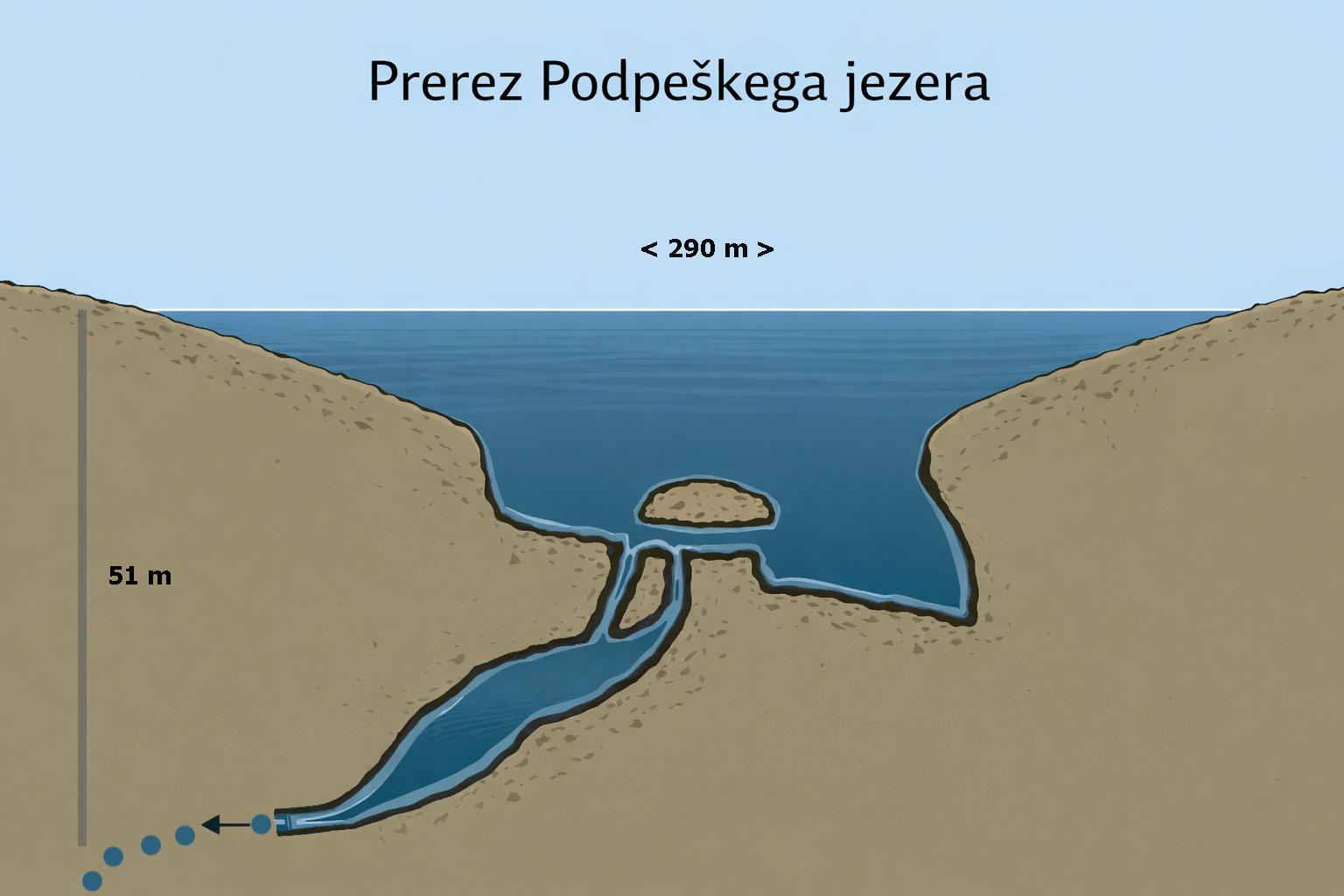
The lake formed within a deep karst collapse depression, created by long-term dissolution of limestone bedrock and progressive collapse of underground cavities. Over extended geological periods in the Dinaric karst, networks of fractures, conduits, and caves developed. When structural instability caused roof collapse, a vertical collapse doline formed, later filled by groundwater from the karst aquifer. It is therefore a classic example of a karst collapse lake rather than a surface or marsh-related hydrological feature.
Despite its clear karst origin, the broader influence of the Ljubljana Marsh is significant in a regional hydrogeological sense. The marsh acts as a large sedimentary basin with a high groundwater table and slow surface drainage, shaping local hydrological conditions along its northern margin. This regional hydrodynamics contributes indirectly to recharge processes in the karst hinterland, where precipitation in the transition zone partially infiltrates into the limestone system.
Podpeško jezero is therefore both an isolated karst water body and a marginal contact phenomenon. Its water is exceptionally clear, originating from the karst aquifer where precipitation percolates through fractured limestone and emerges as cold subterranean inflows. Due to stable recharge and consistent hydrogeological conditions, it is among the deepest natural lakes in Slovenia, reaching depths of approximately 50–51 meters relative to its small surface area.
In landscape terms, the setting is highly distinctive: to the north lies the wide plain of the Ljubljana Marsh, while to the south rise the limestone massifs of the Krim uplands. This sharp boundary creates a strong visual and geomorphological contrast, where karst terrain emerges above the marsh surface while remaining in indirect hydrogeological interaction with it.
The lake water is cold and extremely clear due to karst filtration processes, exhibiting oligotrophic conditions that support specialized aquatic ecosystems. These conditions are stable but sensitive, as they depend directly on the quality and dynamics of the surrounding karst aquifer.
The settlement of Podpeč has historically been associated with limestone extraction in the wider area, where the so-called “Podpeč stone” was used as a building material in Roman Emona and later in Ljubljana. Although this activity is not directly linked to the lake depression itself, it reflects long-term human presence in this marginal karst–marsh transition zone.
Podpeško jezero can thus be understood as a self-contained karst hydrogeological system, spatially embedded within the edge of the Ljubljana Marsh. Its significance lies not in direct hydrological connection with the marsh, but in its position at the interface between two contrasting geological and hydrological systems.