lake
lake / jezero
Spatial representation of terms from geography and 'spatial' sciences

The definition of lakes or ponds, and even more so wetlands, can vary depending on the historical time of the definition, countries, and scientists. What constitutes a "lake" is still a subject of debate. According to some definitions, a lake would consist of fresh water, unlike seas and oceans, which are salty. This definition is incorrect because the Baltic Sea has less than 4 g/l of salt, while the Great Salt Lake has about 250 g/l. Classifying a body of water as a lake or a pond based on its local name in toponymy is also not possible: the same body of water is sometimes popularly called a pond or a lake or a lake and a sea. The boundary between the concepts of lake and pond is blurred. We also know of underground lakes (Križna jama in Slovenia) and even underwater lakes, which represent an accumulation of hypersaline water in the deep sea floor. In 1892, Swiss François-Alphonse Forel, a pioneer of limnology (the science that deals with the study of inland waters), clearly defined a lake. He designated a "lake" as a mass of standing water without a direct connection to the sea, located in a depression in the ground, closed on all sides. A lake is an inland body of water that represents an accumulation of water in a depression on land and, unlike an inland sea, has no direct connection to the world ocean, thus having no inflow or outflow due to ocean currents. Inflow and outflow are usually small compared to the total amount of water in the lake. Unlike a river, a lake has no gradient. The term inland lake is used to distinguish inland lakes from coastal ones (coastal lakes, coastal brackish lakes, or lakes formed by embankments along the coast), as well as to refer to lakes in general. A lake in the sense of the limnological definition is usually much deeper than a pond, pool, or puddle, so that a stable thermal stratification can develop over days to months.
The frequency of their mixing is used to classify lakes, as it also has far-reaching ecological consequences. In this respect, even shallow steppe lakes, such as Lake Neusiedl or Lake Balaton, are not considered "true" lakes (limnologically they are defined as "shallow lakes"). According to a more commonly used definition, lakes are only standing water with a depth of more than two meters. Lakes in the true sense are natural bodies of water, except that in a broader sense they also include artificial bodies of water, such as reservoirs and lakes left over from mining (e.g., Lake Velenje). However, the precise delimitation between lakes and pools/ponds etc. is unclear and always subjective. Therefore, some limnologists call any water-filled depression a lake. For their categorization, it would then be irrelevant whether the lake is constantly or occasionally filled with water. Colloquially, the assignment often depends on salinity, but this is not a criterion. Although a lake usually contains fresh water, there are also large salt lakes, such as the Caspian Sea, the Aral Sea, and the Dead Sea. The term "sea" in these cases is merely historical/cultural descriptive and they are lakes. There are also lakes containing soda, for example those of the Rift Valley in the East African Rift Valley, such as Lake Nakuru, the Anatolian Lake Van, and some lakes around Lake Neusiedl. A further definition can be made by size. The minimum size of a lake is about one hectare. With the help of satellite observation, about 100 million surface lakes were identified on Earth, with an area of more than one hectare. In total, they cover an area of more than 300 million hectares or about 2% of the land surface. This scope only includes lakes larger than one hectare. The share of the remaining small lakes was long underestimated in number: in 2006, a global model, taking into account water surfaces smaller than a hectare based on Pareto's law, doubled the previous estimate, which was 304 million lakes, to a total of 4.2 million square kilometers of land area. Similar analyses based on a census of large artificial dams estimated the area of reservoirs at 0.26 million square kilometers. Adding the many small agricultural or aquaculture reservoirs in the world, the water surface - depending on rainfall - can increase to about 77,000 km2 (2006 study). 4.6 million square kilometers of the Earth's land surface (3%) would thus, if ponds and small reservoirs were taken into account, be covered by water. The depths of the world's lakes are less known and vary considerably depending on the hydrogeological context and sometimes seasonally. Thus, Loch Ness in Scotland has an average depth of 132 meters, more than four times deeper than Lake Erie in North America, which is 4500 times larger in area. Approximate models infer lake depth from the surrounding topography and predict, based on recent research, that the total volume of lakes is from 160,000 to 280,000 square kilometers. Cael, in collaboration with Adam Heathcote and David Seekell, developed a new model for determining the volume of lakes worldwide and using data from several studies, the authors showed that the number of lakes in a given geographical area is in relation to a mathematical power law: the number of lakes statistically decreases over time. The smaller the lakes, the more they are arranged in clusters. The larger the lakes, the rarer and more isolated they are. Small lakes, smaller than 1 hectare, are about 100 times more numerous than lakes with an area of 10 hectares. This mathematical law, combined with additional data, shows that until now the number of small lakes was underestimated. This leads to a reassessment of the total number of lakes in the world and their area upwards, but with an estimate of their average depth downwards. If these lakes are actually shallower than previously thought, they likely emit more methane than expected. Their role as carbon sinks would be less significant than expected and their contribution to global warming greater than expected. With warming and due to increased organic matter input from eutrophication and erosion caused by human activities, especially agriculture, this contribution could increase further. The latest estimate of volume and depth is based on percolation theory (Darcy's law), as well as on a topographical mathematical model of the Earth. The calculation then gives a total lake volume of 199,000 km3 and an average depth of only 42 meters. These studies based on a mathematical model are general, but other factors have influenced the number, volume, and area of lakes on historical or geological timescales: this is, for example, the decline in beaver populations, whose dams maintained a large number of water bodies until the early Middle Ages. Then, the development of agricultural irrigation and groundwater pumping and the formation of many small lake ponds must also be taken into account. In 1957, British ecologist George Evelyn Hutchinson published a monograph titled 'A Treatise on Limnology', which is considered a landmark treatise and classification of all major types of lakes, their origin, morphometric characteristics, and distribution. Hutchinson presented an extensive analysis of lake formation in his publication and proposed a generally accepted classification of lakes according to their origin. This classification recognizes 11 main types of lakes, which are divided into 76 subtypes. The eleven main types of lakes are:
TECTONIC LAKES: Tectonic lakes are formed due to deformation and consequent lateral and vertical movements of the Earth's crust. These movements include faulting, tilting, folding, and warping. Some of the largest lakes on Earth are tectonic lakes filling tectonic faults, e.g., the Central African lakes filling fault depressions (Lake Tanganyika, etc.) and Lake Baikal in Siberia. Other well-known tectonic lakes include the Caspian Sea and other lakes that were separated from the sea when tectonic uplift of the seafloor raised them above ocean level. Often, tectonic stretching of the crust created an alternating series of parallel grabens (sunken areas of the crust bounded by faults) and horsts (uplifted areas of the crust bounded by faults), forming elongated basins that alternate with mountain ranges. Not only does this promote lake formation due to disturbances of pre-existing drainage networks, but in arid regions, it also creates endorheic basins containing saline lakes (also called salt lakes). They form where there is no natural outlet, high evaporation rates, and the groundwater drainage area has higher than normal salt content. Examples of these salt lakes are the Great Salt Lake and the Dead Sea.
VOLCANIC LAKES: Volcanic lakes fill either local basins, e.g., craters and maars, or larger depressions such as calderas created by volcanism. Crater lakes form in volcanic craters and calderas that fill with precipitation faster than they drain either by evaporation, groundwater discharge, or a combination of both. Sometimes the latter are called caldera lakes, although there is often no distinction. An example is Crater Lake in Oregon, in the caldera of Mount Mazama. The caldera was formed in a major volcanic eruption around 4860 BC, which caused the collapse of Mount Mazama. Other volcanic lakes form when rivers or streams are dammed by lava flows or volcanic lahars. The drainage basin that is now Lake Malheur in Oregon was formed when a lava flow dammed the Malheur River. Among all lake types, volcanic crater lakes come closest to a circular shape.
GLACIAL LAKES: Glacial lakes are formed by the direct action of glaciers and continental ice sheets. Numerous glacial processes create closed basins. Consequently, there are many different types of glacial lakes and it is often difficult to define clear distinctions between different types of glacial lakes and lakes influenced by other activities. General types of glacial lakes that have been recognized are lakes in direct contact with ice, glacially carved rock basins and depressions, moraine, and outwash lakes. Glacial lakes are the most numerous lakes in the world. Most lakes in northern Europe and North America were influenced by the last glaciation. Glacial lakes include proglacial lakes, subglacial lakes, finger lakes, and epishelf lakes. Epishelf lakes are highly stratified lakes in which a layer of fresh water derived from ice and snowmelt is dammed behind an ice shelf attached to the coast. They are mostly found in Antarctica.
FLUVIAL LAKES: Fluvial lakes are formed from flowing water. These lakes are dammed rivers where sediments from a tributary block the main river, cut-off river meanders, or lateral lakes where sediments from the main river block a tributary, usually in the form of a levee. The most common type of fluvial lake is the oxbow lake, named for its characteristic curved shape. They can form in river valleys as a result of meandering. A slow-flowing river forms a winding shape as the outside of the bends erodes faster than the inside. Over time, a horseshoe bend forms and the river cuts through the narrow neck. This new passage then forms the main passage for the river and the ends of the bend silt up, thus forming a bow-shaped lake. Their crescent shape gives oxbow lakes a higher perimeter-to-area ratio than other types of lakes.
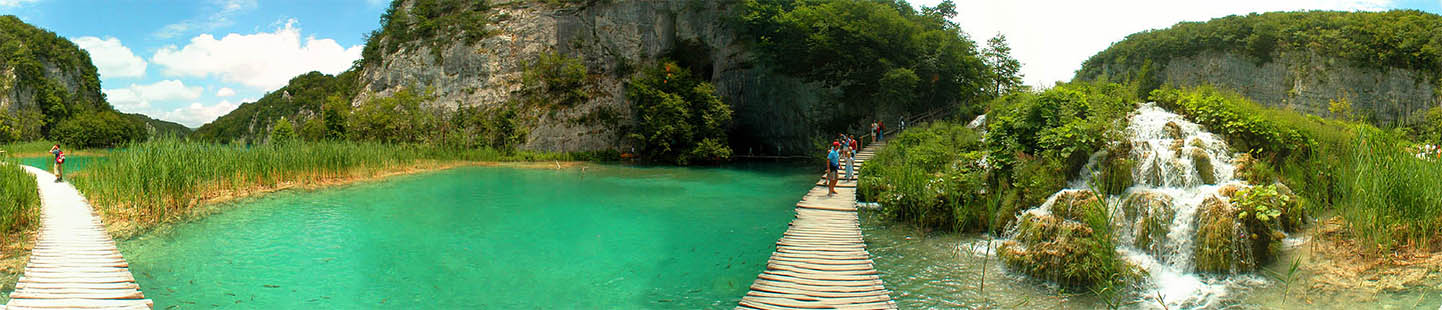
SOLUTION LAKES - KARST LAKES: Such a lake fills a depression formed by surface dissolution of rock. In areas covered by soluble rock, its solution by precipitation and water percolation usually results in cavities. These cavities often collapse and form sinkholes, which are part of the local karst topography. Where groundwater lies close to the ground surface, the sinkhole will be filled with water as a solution lake. If such a lake consists of a large area of standing water occupying an extensive closed depression in limestone, it is also called a karst lake. Smaller lakes consisting of standing water in a closed depression within a karst area are called karst ponds. There are many classic examples of karst lakes in the karst areas along the Dalmatian coast of Croatia and the large area of Florida in the USA.
LANDSLIDE DAMMED LAKES: A dammed lake is formed due to the blockage of a river valley by mudflows, landslides, or scree. Such lakes are most common in mountainous areas. Although landslide-formed lakes can be large and quite deep, they are usually short-lived. An example of a landslide lake is Quake Lake, formed as a result of the Hebgen Lake earthquake in Montana (USA) in 1959. Most dammed lakes disappear in the first few months after formation, but a landslide dam can later suddenly burst and threaten the population downstream when water drains from the lake. In 1911, an earthquake triggered a landslide that blocked a deep valley in the Pamir Mountains in Tajikistan, forming Lake Sarez. Lake Tal-y-llyn in North Wales (UK) is a lake formed by a landslide from the period of the last glaciation in Wales about 20,000 years ago.
AEOLIAN LAKES: Aeolian lakes are formed by wind action. These lakes are found primarily in arid environments, although some aeolian lakes are relict landforms indicating an arid paleoclimate. Aeolian lakes consist of lake basins dammed by wind-blown sand; interdunal lakes lying between well-oriented sand dunes; and deflation basins formed by wind action in a previously arid paleoenvironment. Moses Lake in Washington, USA, was originally a shallow natural lake and an example of a lake basin dammed by wind-blown sand.
SHORELINE LAKES: Shoreline lakes are formed due to the blockage of river estuaries or due to the uneven accumulation of coastal ridges by coastal and other currents.
ORGANIC LAKES (PEAT LAKES): Peat lakes are a form of organic lake. They form where the accumulation of partially decomposed plant material in a wet environment leaves a vegetative surface below the water table for a long time. They often have few nutrients and are slightly acidic, with little dissolved oxygen at the bottom.
ANTHROPOGENIC LAKES: Anthropogenic lakes are artificially created as a result of human activity. They can be formed by intentional damming of rivers and streams or subsequent filling of abandoned excavations with groundwater, precipitation, or a combination of both.
METEORITE LAKES: Meteorite lakes, also known as crater lakes (not to be confused with volcanic crater lakes), are formed by catastrophic impacts of extraterrestrial objects (meteorites or asteroids) on Earth. Examples of meteorite lakes include Lake Lonar in India, Lake El'gygytgyn in northeastern Siberia, and Pingualuit Crater Lake in Quebec, Canada. Like in the cases of El'gygytgyn and Pingualuit, meteorite lakes can contain unique and scientifically valuable sediments associated with long records of paleoclimatic changes.
Literature: Adrian Cho (2017), World's lakes are shallower than assumed, mathematical analysis suggests; March 17, 2017; study led by MIT oceanographer B.B. Cael at MIT, Cambridge, based on a presentation of the study in The Volume of Earth's Lakes; Chair: Mary Silber, University of Chicago; Session F12: Formation of Natural Patterns and the Earth's Climate System; APS March Meeting 2017; March 13–17, 2017; New Orleans (Louisiana); B.B Cael, A. J. Heathcote et D. A. Seekell, « The volume and mean depth of Earth's lakes », Geophysical Research Letters, vol. 44, 13 janvier 2017, p. 209-218; Boštjan Burger, Hydrology of the Triglav National Park, 1999; Cooper, C. M. (1993); Downing, J. A. et al. (2006); Hutchinson, G. E. (1957) A Treatise on Limnology; Veillette et al. (2008); Desiage et al. (2015).