

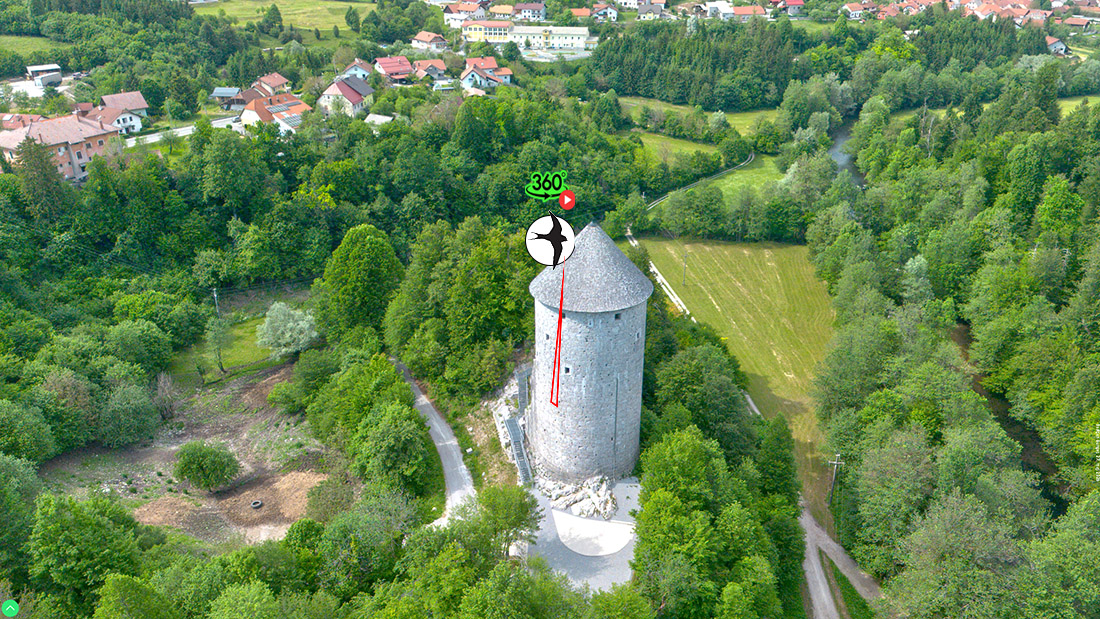
Ravbarjev stolp stands on a prominent rocky outcrop above the western edge of the Planinsko polje, directly beside the ponor where the Unica River disappears into the Planinska jama cave system. With its exposed position above one of the largest karst sinkholes in Slovenia, the tower controlled the passage between the Ljubljana Basin and the interior of the Dinaric Karst for centuries. Owing to this strategic location, it formed an important part of the defensive and surveillance system that protected routes, estates, and transport flows across the Notranjska region.
Geographical setting
The tower is situated on a slightly elevated karst terrace that offers a wide view over the entire Planinsko polje and the old route leading toward Postojna. Just below it, the Unica retreats underground into Planinska jama, which in the past represented both a natural barrier and a controlled crossing point. Because of the field’s dynamic hydrology—seasonal flooding, sinkholes, and intermittent drainage—this area has always been sensitive and strategically significant.
History and origins
Ravbarjev stolp was built in the 15th century, during a period of intense Ottoman incursions. The noble families who managed the estates on Planinsko polje fortified key passages, including the area around the Unica ponor. The tower was conceived as an independent defensive structure that complemented the wider system of fortifications connected with the nearby Haasberg (Hošperk) Castle. Local tradition associates it with “ravbarji”—robber knights who supposedly controlled the passage and plundered travellers from the tower—although historical sources do not confirm this. Nevertheless, the legend became part of local identity and gave the tower its enduring name.
Ravbarjev stolp is closely linked to the development of estates on Planinsko polje, which throughout the Middle Ages were held by several important noble lineages. The earliest known lords of the wider area were the Eppenstein family and later the Spanheims, who controlled much of Notranjska in the 11th and 12th centuries. After the extinction of the Spanheims, the territory passed to the Counts of Gorizia, and in the 14th century to the Habsburgs, who granted the estates as fiefs to various ministerials and lower nobility.
The tower is most closely associated with the Haasberg (Hošperk) family, who administered the nearby castle above Planina. In the 15th century, the castle and its estates were owned by the Counts of Luegg (Lueger), the most famous among them being Erasmus of Predjama, who also held lands on Planinsko polje. After the extinction of the Lueggs, the estate passed to the Eggenbergs, and in the 17th century to the Windischgrätz family, who remained the principal landowners until the 20th century.
Does the tower truly date to the 15th century?
Although Ravbarjev stolp is most commonly dated to the 15th century—consistent with the period of Ottoman raids and widespread fortification of key passes—archaeological and historical indicators suggest that the tower may have an older foundation:
• Location – its position on a naturally exposed promontory above the Unica ponor is typical of early‑medieval watchpoints. • Ground plan – round towers became widespread in the 15th century, but examples from the 13th–14th centuries are also known in Notranjska, especially at sites controlling routes and toll points. • Lack of early written sources – the first reliable mentions of the tower are late, which is typical for small defensive structures that often existed earlier but were not formally recorded. • Connection with early landholders – the Counts of Gorizia and their ministerials controlled an important transport route between the Ljubljana Basin and the Postojna Basin in the 13th and 14th centuries; overseeing the Unica ponor would have been strategically logical.
Although no direct evidence confirms the existence of the tower before the 15th century, it is likely that a smaller fortification or watchtower stood here earlier and was replaced or substantially rebuilt in the 15th century.
Connection with the Ravbar family
The tower’s name derives from local folklore about “ravbarji”—robber knights who allegedly monitored the passage and plundered travellers. However, the name may also be linked to the Ravbar (Rauber) family, active in the 15th century in Carniola and Notranjska, where they held estates. Although no direct evidence shows that the Ravbar family controlled the tower, it is possible that local tradition merged their name with the motif of robber knights, giving the tower its present name.
Purpose and function
The tower’s primary functions were to control the passage between Planinsko polje and the karst edge, protect the trade route toward Postojna, serve as a warning and defensive point during Ottoman incursions, and act as an auxiliary structure within the Haasberg estate. Its position allowed rapid surveillance of activity on the polje and control over access to the Unica ponor, which was important both as a water source and as a natural boundary of the estate.
Architectural characteristics
Ravbarjev stolp has a circular ground plan, typical of late‑medieval defensive structures built for greater resistance to siege and fire. It is constructed from local limestone, with massive walls and small openings that served as arrow slits. The interior was divided into several wooden floors used for living, storage, and defence.
Restoration works
After centuries of gradual decay, the tower was in very poor condition by the 20th century. Key restoration works were carried out in several phases. In the 1970s and 1980s, the first urgent structural reinforcements stabilised the most damaged sections of the walls. Between 1997 and 1999, a more extensive conservation project led by the Institute for the Protection of Cultural Heritage of Slovenia strengthened the masonry, repaired cracks, and partially reconstructed the wall crown. Additional protective works followed between 2014 and 2016, including cleaning and consolidation of the exterior, as well as improvements to the surrounding area and access paths. All restoration efforts adhered to conservation guidelines, emphasising the preservation of the tower’s authentic stone structure.
Contemporary significance
Today, Ravbarjev stolp is an important element of the cultural landscape of Planinsko polje and holds multiple layers of value. As one of the few preserved standalone medieval defensive towers in Notranjska, it possesses significant cultural‑historical importance and illustrates defensive strategies and land management in the late Middle Ages. Its distinctive silhouette enhances the landscape of the western edge of the polje and the Unica ponor, giving it strong symbolic and scenic value.
The tower is an important research source for the study of medieval architecture, settlement patterns, and the use of karst landscapes. Its position beside one of Slovenia’s most striking karst phenomena allows for the integration of cultural and natural heritage, serving as a point of interpretation for the intermittent polje, karst sinkholes, and underground water systems. It is also a popular excursion destination, offering visitors insight into history, landscape, and environmental dynamics, and thus holds significant educational and tourist value.