

Begunje lies on a scenic alluvial fan beneath the Draga Valley, at the point where the Dežela region, the Kamnik–Savinja Alps, and the mighty Karavanke Mountains meet. Owing to its location, the settlement has been of strategic importance since ancient times and is first mentioned in written sources as early as the 11th century. From this early period also originate the ruins of the former Hudičev gradič (Devil’s Castle), which was explicitly recorded in documents in 1185. In the immediate vicinity of the village lies the archaeologically significant Zijalka cave, bearing witness to human presence in this area in much earlier periods.
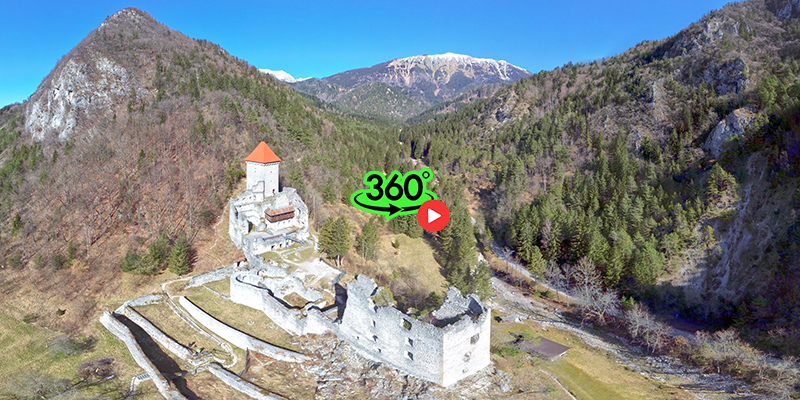
During the Middle Ages, Begunje became the center of the Gorenjska estates of the Counts of Ortenburg, who built Kamen Castle in the 12th century at a strategically chosen location. This imposing fortress controlled important routes for centuries and protected the surrounding population. Today, its ruins are among the most recognizable cultural landmarks of the area. Yet Begunje is not only a place of history—it is also surrounded by remarkable natural beauty. Numerous waterfalls are hidden in the vicinity, among the best known being Blatnica and Luknja, attracting lovers of nature and photography.
The village is also a starting point for many hiking trails leading to nearby peaks. West of the settlement rises a hill crowned by the Church of St. Peter, built at an elevation of 839 meters; today, it is a popular take-off site for paragliders who take advantage of favorable wind conditions. Both sacred and secular architecture in Begunje testify to its rich cultural heritage. The parish church of St. Ulrich was first mentioned in 1403, while the Katzenstein Manor is documented as early as 1537.
Over the centuries, the manor underwent numerous transformations, and in the 20th century it also became a symbol of a tragic chapter in history, as it was the scene of grim events during the Second World War. Nevertheless, the post-war period brought renewed momentum—economic development placed Begunje on the global map, primarily through the emergence and success of the ELAN brand, which became synonymous worldwide with top-quality skis and sporting innovation.
The village is also internationally renowned for its musical heritage. Begunje is the birthplace of the Avsenik Brothers Ensemble, whose distinctive Alpine folk music shaped Slovenian cultural identity and became an international phenomenon. Among the architectural gems is also the Chapel of St. Joseph, built in 1940 according to the plans of one of Slovenia’s most important architects, Jože Plečnik.
Today, Begunje represents a harmonious intertwining of history, nature, culture, and modern development. It is a place where past and present meet in the vibrant rhythm of everyday life, while at the same time serving as a gateway for exploring the wider Gorenjska region and its many stories.